

You already own a pair of running sneakers. You like how they feel underfoot, you like how they look with jeans, and you would rather not buy a second pair just to stand on a sidewalk all day. So the question is fair: can you wear running shoes for walking? The short answer is yes, most of the time. The longer answer is where it gets interesting, and it is the difference between a pair that feels great at hour eight and one that leaves your feet asking questions.
What running shoes actually do differently
Running is a repetitive, high-impact motion that happens mostly on the forefoot and midfoot, at a faster cadence than walking, and in a straight line. Walking is slower, longer, and far more varied – curbs, stairs, tile, long stretches of concrete. Shoe designers optimize for those different jobs, and the gap shows up in a handful of places.
Cushioning, drop, and rocker geometry
Running sneakers carry more foam under the forefoot and often a higher heel-to-toe drop. Many also build in a rocker shape, a curve at the toe that rolls you forward through each stride. For walking, that rocker can feel efficient and springy, or it can feel like the shoe is pushing you faster than you want to go. Drop matters too: a bigger drop shifts load toward the heel and knees, which some walkers love and others find tiring.
Breathability and weight
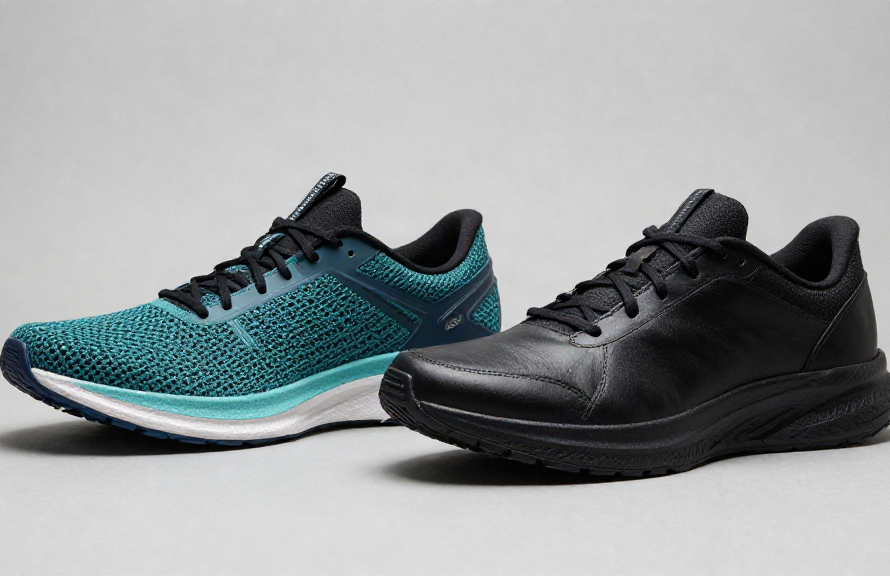
Engineered mesh uppers are the big win. Running shoes are built to move air, which makes them genuinely pleasant for warm commutes, long airport days, and standing shifts. The tradeoff is that lightweight mesh flexes more and offers less structure than a sturdier walking or casual shoe, so a very flexible pair can feel unstable over many hours on hard floors.
Can you wear running shoes for walking all day?
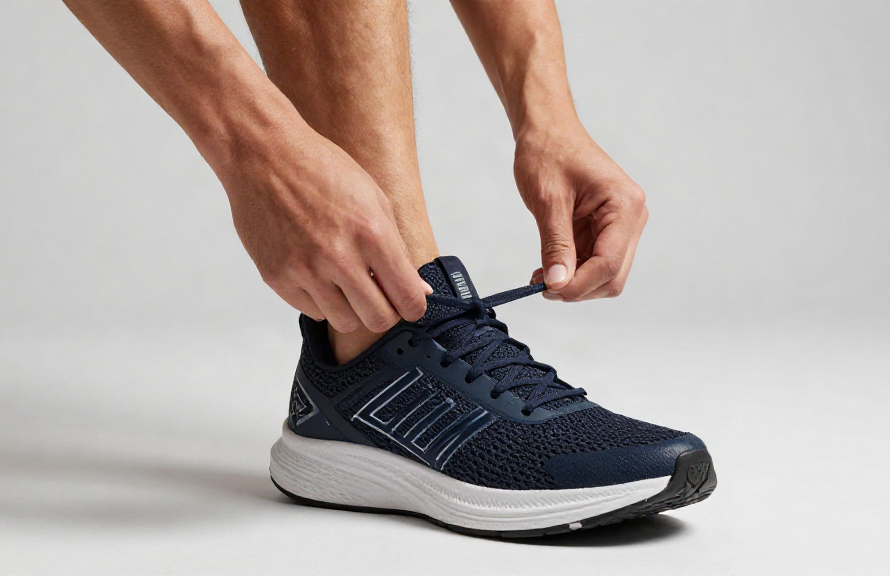
Yes, and plenty of people do. Nurses, teachers, commuters, and travelers routinely put ten-plus hours into running sneakers, and modern foam holds up fine for that. The key word is fit. A running shoe sized for a fast 5K, laced tight for lockdown, is not the same shoe you want at hour nine of a walking day. Go up half a size if your toes need room, lace looser through the midfoot, and swap in a firmer insole if the factory one packs out fast.
When running sneakers work for walking
They work best when your day is a mix. A walk to the train, a few hours on your feet, a lunchtime loop, maybe a run after work – this is exactly the gym-to-street life running sneakers were made for. They also shine if you want one pair for travel, or if you like a soft, energetic ride and your knees appreciate the extra foam.
Lightweight mesh pairs are especially good in heat, and low-profile sneakers that look like streetwear rather than gym gear make the transition from track to sidewalk feel natural instead of like you forgot to change shoes.
When they do not
Be honest about three situations. First, if you pronate heavily or need real arch support, a soft neutral running shoe may let your foot roll too far, and a stability-focused walking shoe will serve you better. Second, if you stand on concrete for eight hours straight with almost no walking, a firmer, wider shoe with a stiff heel counter usually wins. Third, if you have plantar fasciitis or heel pain, a very flexible, high-cushion runner can make it worse – cushioning is not the same thing as support.
There is also the wear question. Running foam is designed to rebound, and walking compresses it in a different pattern. Use one pair for both and you will likely replace it sooner than a dedicated rotation would require. That is a cost, not a dealbreaker.
Does walking in running shoes ruin them?
Not ruin, but it does change the clock. Foam loses bounce after roughly 300 to 500 miles of running, and walking adds miles that count toward that total. If you walk five miles a day in your running shoes, expect to retire them earlier. Keep the pair you race or do long runs in separate from the pair you wear to the grocery store and both will last longer.
Can you run in walking shoes?
This is the direction that hurts. Walking shoes are stiffer, heavier, and built with less forefoot cushioning, so running in them puts more shock through your ankles and shins. If you are choosing one pair for both, pick the running shoe and adjust how you lace and what you wear with it, rather than picking the walking shoe and hoping.
How to pick one pair for both
Start with the fit, then the look, then the foam. We build GORUN sneakers for exactly this overlap – a shoe that handles a training session and still looks right on the street afterward.
For road runs and long walking days, the SHARK men’s blue and green mesh sneaker pairs lightweight cushioning with a breathable upper. If you want something bolder for the walk-home half of your day, the Evil555 black and red wave print or the BLUWAVER unisex teal and black abstract mesh both bring graphic energy without adding weight. The FLY 71 black and white pair is the quietest of the group, easy to wear with anything.
For a leather finish, the REX-LOB low-top in black, red, and hot pink holds structure better over long hours, while the DAYFLOW women’s purple abstract leather low-top does the same with a softer palette. And if you like a high-top silhouette for ankle coverage on cool days, the neon green and black abstract high top is the one to try. All of them sit in our accessible range, so a second pair for rotation is not an unreasonable idea.
The bottom line
You can wear running shoes for walking, and for most active people they are a smart, comfortable choice – especially if your day blends movement with sitting, commuting, and the occasional run. Pay attention to fit, give your feet room, and be honest about whether you need support rather than softness. Then get out there. More movement, more miles, one pair that keeps up.
Ready to find yours? Browse the full GORUN lineup and pick the pair that goes from track to street without missing a step.